

Research Perspectives on Educational Technology Use
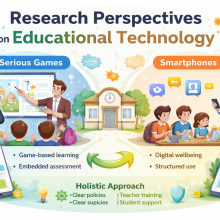
Technology in the Classroom: Parallels Between Game-Based Learning Research and Smartphone Use in K–12 Education
Serious Games in Education
Young et al. (2012) review research on serious gaming and explain why broad claims such as “games improve achievement” often fail to hold across K–12 contexts.
Researchers frequently treat video games as a single intervention category. However, game mechanics, goals, and social structures vary widely, making research findings difficult to compare and replicate.
The authors also highlight a recurring implementation problem. In many schools, gameplay is compressed into short, individual, tightly scheduled activities. This removes the extended engagement, collaboration, and continuity that often shape learning in game-based environments.
Regarding measurement, the researchers recommend moving toward embedded assessment and trace data (e.g., log files). Traditional post-test snapshots fail to capture interaction dynamics and learning trajectories that occur during gameplay.
The review also reports uneven evidence across subject areas, with stronger support for language learning than for science and mathematics achievement.
Finally, several key limitations in the research base are identified:
-
Poor specification of treatment variables and outcomes
-
Narrow outcome measures centered mainly on achievement
-
Lack of long-term studies (most implementations last only weeks rather than months or years)
Smartphone Use in K–12 Education
Miltenoff and Zvetanski (forthcoming) examine smartphone use in K–12 education between 2020 and 2025, describing smartphones as both an opportunity and a disruption.
Their analysis synthesizes international reports and peer-reviewed studies showing that unregulated smartphone use is associated with:
-
increased distraction and attention costs
-
cyberbullying risks
-
equity gaps
-
additional teacher workload
At the same time, structured and purposeful use can support:
-
improved access to learning resources
-
student engagement
-
differentiated instruction
The authors describe diverging policy responses worldwide, ranging from national or regional restrictions to guided BYOD (Bring Your Own Device) approaches.
They emphasize that teacher readiness and technostress significantly influence whether any smartphone policy works in practice.
Research suggests that smartphone bans may produce moderate academic and social benefits, but they rarely address broader wellbeing issues or out-of-school screen-time habits. Therefore, schools need a holistic digital wellbeing strategy combining:
-
clear policies
-
teacher professional development
-
student digital literacy
-
family engagement
Key Parallel Between the Two Research Lines
Taken together, the two studies highlight a strong parallel:
Schools achieve better outcomes when technology is treated as part of an instructional and organizational system, rather than as a stand-alone solution or an isolated risk factor.
Young et al. (2012) locate effectiveness in:
-
alignment between game goals and learning goals
-
teacher facilitation
-
assessment embedded within gameplay activities
Miltenoff and Zvetanski (forthcoming) locate effectiveness in:
-
intentional pedagogy
-
consistent policy enforcement
-
teacher capacity to manage classroom norms and protect wellbeing
Both studies also warn against binary framings.
Young et al. (2012) reject the generic question “Do games work?” and instead call for research examining interactions between learner, tool, and context.
Similarly, Miltenoff and Zvetanski argue that the debate framed as “ban versus allow smartphones” misses the practical conditions that determine classroom outcomes.
A key difference lies in control and scope. Schools typically select specific educational games and can instrument gameplay for embedded assessment. Smartphones, however, are student-owned general-purpose devices that provide constant access to communication and social media. This increases policy complexity and introduces wellbeing risks beyond academic performance.
References
Young, M. F., Slota, S., Cutter, A., Jalette, G., & Mullin, G. (2012).
Our Princess Is in Another Castle: A Review of Trends in Serious Gaming for Education.
Review of Educational Research, 82(1), 61–89.
https://doi.org/10.3102/0034654312436980
Miltenoff, P., Zvetanski, Z. (forthcoming).
Between Innovation and Overload: Smartphone Use, Teacher Readiness, and Digital Wellbeing in K–12 Education.