This information comes from CEI’s previous website. We review and update these materials in stages.
PAIDEIA is funded by Erasmus+ under Partnerships for Innovation – Forward-Looking Projects. It connects advances in artificial intelligence with teaching practice. The project gives educators the knowledge and skills to use AI to improve learning, with attention to its ethical, social and practical implications.
PAIDEIA develops a competency framework that identifies what educators need to know and do to use AI in teaching and learning. It creates training materials and practical educational resources. It also provides a space for educators, policymakers, researchers and other stakeholders to share experience and discuss the use of AI in education.
Partners and collaboration
Universities, research institutes and education authorities from across Europe bring different perspectives to the consortium. Universities contribute research methods and theoretical foundations for the framework and learning materials. Research institutes bring current expertise in AI. Education authorities and providers help make the outcomes relevant, accessible and usable in existing education systems.
Public institutions help the project reach policymakers and education and training systems. They connect the consortium with decision-makers and share its forward-looking approaches. In Malta, the Ministry for Education, Sport, Youth, Research and Innovation (MEYR) works through its Directorate for Digital Literacy and Transversal Skills to strengthen digital skills in schools and contributes to European work on the evaluation of AI in education. The ministry leads policy and uptake activities. Institutional partners work together on a roadmap for sustainability and use of the project results. They also prepare guidance for EU, national and regional policymakers on gender equality and impartiality in institutional communication. Dublin City University supports this work through a network on AI in education and future-oriented digital skills for teachers.
The Government of Aragon works on teacher training and digital skills across levels of education. The Regional School Office for Tuscany supports teacher training and the introduction of digital skills in one of Italy’s largest education regions. The Governorship of Istanbul and its provincial education directorate bring experience spreading new approaches to teacher training and coordinating Erasmus+ at national level. Bulgaria’s National Inspectorate of Education implements state standards for inclusive education, helps disseminate training programmes and takes part in the European network of state inspectorates.
Dublin City University and the University of Milan lead a group of universities in reviewing current research on AI in education and relevant EU position papers. The universities also contribute to the curriculum and the project’s principal outcome, the competency framework.
Consortium
• Fondazione Hallgarten-Franchetti Centro Studi Villa Montesca, Italy, coordinator • Dublin City University, Ireland • UC Leuven and UC Limburg, Belgium • Università degli Studi di Milano, Italy • Fundación Universidad San Jorge, Spain • Governorship of Istanbul, Türkiye • National Inspectorate of Education, Bulgaria • Ministry for Education, Sport, Youth, Research and Innovation, Malta • Government of Aragon, education authority, Spain • Regional School Office for Tuscany, Italy • Center for Educational Initiatives, Bulgaria
Main areas of work
• Study teaching approaches and the use of AI in education.
• Develop a teacher competency framework informed by existing European frameworks and policies.
• Create a curriculum and materials for the pedagogically sound and ethical use of AI.
• Pilot the training with teachers from partner countries in real education settings.
• Prepare guidance and policy recommendations based on the results.
AI in Schools – Interactive Handbook (opens in a new tab)
Classroom scenarios, a teacher workshop and fillable templates for school teams. The handbook adapts PAIDEIA materials for Bulgarian schools and is available in Bulgarian.
PAIDEIA training platform (opens in a new tab)
The project’s official professional development platform for teachers on using artificial intelligence in education.
Teachers Talk About PAIDEIA (opens in a new tab)
An interview in Bulgarian on how teachers use AI to prepare lessons and teach, with a link to the project’s videos.
PAIDEIA newsletter no. 5 (Bulgarian)
This issue covers the pilot training, the partner meeting in Istanbul and preparation of the final materials.
Download the newsletter (PDF)PAIDEIA newsletter no. 1
The project’s first newsletter in English.
ExplorePAIDEIA report D2.1 on artificial intelligence in education
A project report in English.
ExplorePAIDEIA analytical report on the Bulgarian pilot (English)
An English-language report on how the training programme was delivered in Bulgaria.
Explore
PAIDEIA national report on the Bulgarian pilot
Analysis of participation, progress in Moodle and feedback from teachers in the Bulgarian pilot. The report is in Bulgarian.
ExplorePAIDEIA comparative analysis of the pilots in seven countries
A synthesis of the national pilots prepared for the consortium’s final reporting.
ExplorePAIDEIA newsletter no. 1 (Bulgarian)
A resource from the PAIDEIA project.
ExplorePAIDEIA newsletter no. 2 (Bulgarian)
A resource from the PAIDEIA project.
ExplorePAIDEIA survey and focus group findings (Bulgarian)
A resource from the PAIDEIA project.
ExploreAI and teaching theories – Impacts, challenges and opportunities (Bulgarian)
A resource from the PAIDEIA project.
ExploreAI in education – State of play, policies and teaching practices (Bulgarian)
A resource from the PAIDEIA project.
ExploreTeachers’ views on AI in education – Survey and focus group results (Bulgarian)
A resource from the PAIDEIA project.
ExploreCompetency framework for the use of AI in education (Bulgarian)
A resource from the PAIDEIA project.
ExplorePAIDEIA newsletter no. 3 (Bulgarian)
A resource from the PAIDEIA project.
ExplorePAIDEIA newsletter no. 4 (Bulgarian)
A resource from the PAIDEIA project.
ExplorePAIDEIA objectives and expected results
A May 2024 article on the project’s objectives and preparing teachers to use artificial intelligence.
Explore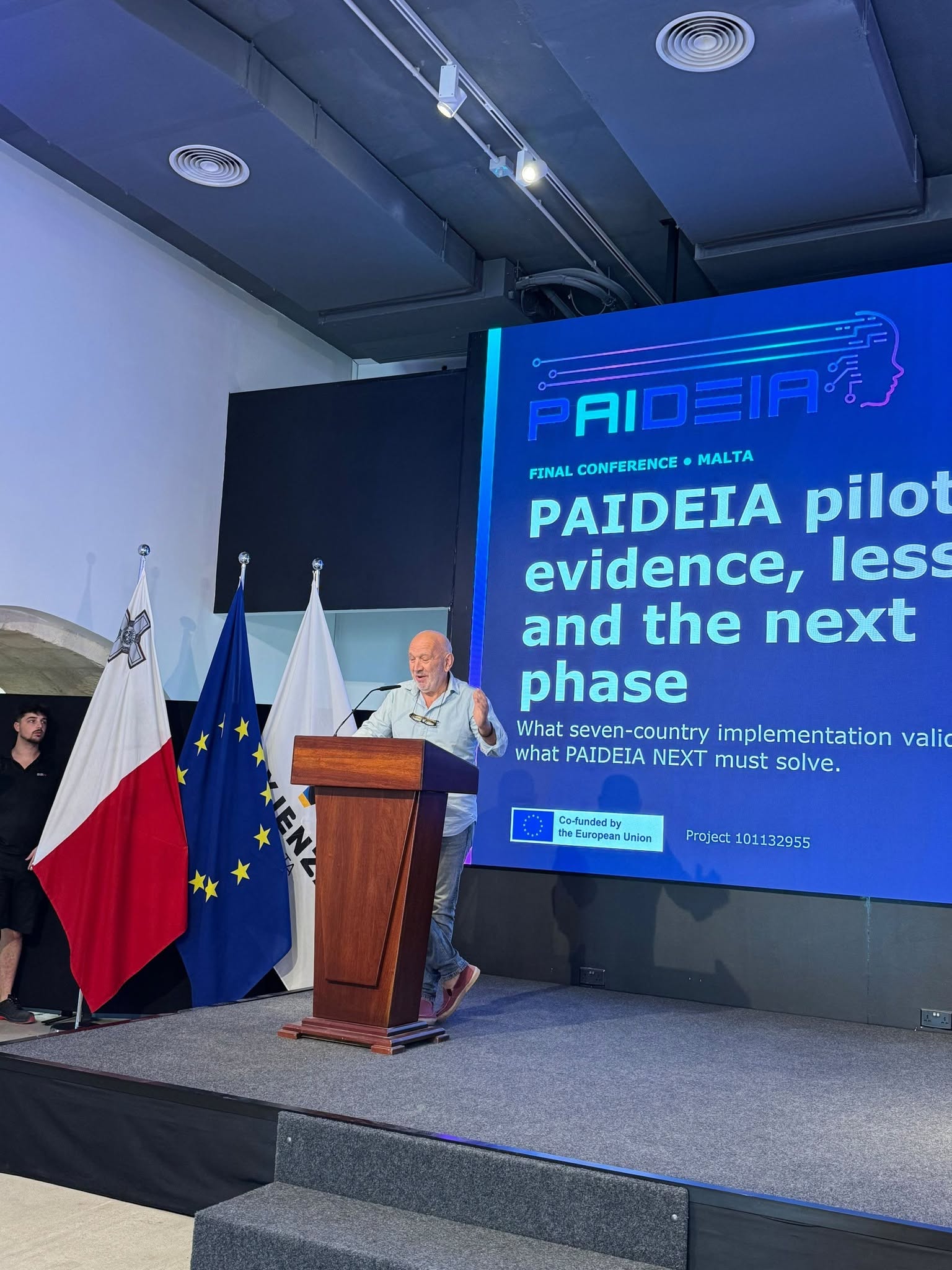 Illustrative photo.Project news29 September 2026
PAIDEIA presents seven countries’ pilot results in Malta
Partners discussed how a common teacher training framework works in different education systems and how the programme can continue after the project.
ExploreWhat we learned from the Bulgarian PAIDEIA pilot
The first module reached 250 participants. Of these, 123 completed the assessment cycle. Teachers’ feedback points to ways to improve the training.
ExplorePhoto from the PAIDEIA project.Project news · PAIDEIA9 June 2025PAIDEIA at the halfway point
In 2025, the partners presented what they had accomplished by the project’s midpoint.
Explore Illustrative photo.Project news1 November 2024
PAIDEIA report examines artificial intelligence in education
The report looks at education policy, practice and teacher preparation in the partner countries.
Explore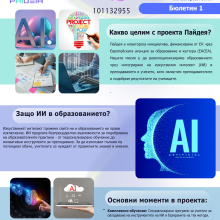 Illustrative photo.Project news20 August 2024
PAIDEIA publishes its first newsletter
The first newsletter introduces the project’s aims and main activities.
Explore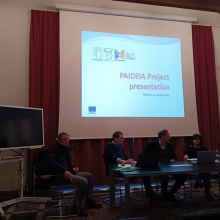 Illustrative photo.Project news14 March 2024
PAIDEIA gets under way
The partners started their joint work at a meeting in Florence.
Explore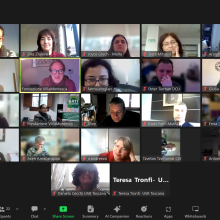 Illustrative photo.Project news20 December 2023
PAIDEIA, a project on artificial intelligence in education
The Center introduces the new European partnership and its role in the pilot.
Explore